
Everything with the band is going so much better than I could have imagined. I'm having so much fun and really enjoy the music I'm singing. Most of it anyway. I also really love the people I play with. I couldn't ask for a better or more talented group of people to play with. The people that I have had the chance to meet have made all the difference as well. I've made some amazing friends and have met some very sweet, supportive people. My stage fright is not even close to being what it used to be. I do still have moments where I get nervous, but I know that as soon as I'm on stage and a few songs in, I'll feel better. This is definitely what I was meant to do and I can't believe it took me so damn long to do it! Having my dad playing in the band with me is pretty fucking amazing, too. That's something I will always cherish and I really hope I'm making my family proud.

Health
A few different things have happened this year health wise. I probably won't even remember everything, to be honest. I should have taken notes to follow for this post. Oh well. Too late.
One thing that happened was I was diagnosed with Hashimoto's disease. I'm still not super clear on what this is myself, but I will try to explain it as best as I can.
HASHIMOTO’S DISEASE
This condition is an autoimmune disease that causes the thyroid to become inflamed, which affects the thyroid’s ability to produce hormones and often results in hypothyroidism.
Overview
Hashimoto's disease is a condition in which your immune system attacks your thyroid, a small gland at the base of your neck below your Adam's apple. The thyroid gland is part of your endocrine system, which produces hormones that coordinate many of your body's functions.
Inflammation from Hashimoto's disease, also known as chronic lymphocytic thyroiditis, often leads to an underactive thyroid gland (hypothyroidism). Hashimoto's disease is the most common cause of hypothyroidism in the United States. It primarily affects middle-aged women but also can occur in men and women of any age and in children.
Doctors test your thyroid function to help detect Hashimoto's disease. Treatment of Hashimoto's disease with thyroid hormone replacement usually is simple and effective.
Symptoms
You might not notice signs or symptoms of Hashimoto's disease at first, or you may notice a swelling at the front of your throat (goiter). Hashimoto's disease typically progresses slowly over years and causes chronic thyroid damage, leading to a drop in thyroid hormone levels in your blood. The signs and symptoms are mainly those of an underactive thyroid gland (hypothyroidism).
Signs and symptoms of hypothyroidism include:
- Fatigue and sluggishness
- Increased sensitivity to cold
- Constipation
- Pale, dry skin
- A puffy face
- Brittle nails
- Hair loss
- Enlargement of the tongue
- Unexplained weight gain
- Muscle aches, tenderness and stiffness
- Joint pain and stiffness
- Muscle weakness
- Excessive or prolonged menstrual bleeding (menorrhagia)
- Depression
- Memory lapses
When to see a doctor
See your doctor if you develop these signs and symptoms:
- Tiredness for no apparent reason
- Dry skin
- Pale, puffy face
- Constipation
You'll also need to see your doctor for periodic testing of your thyroid function if:
- You've had thyroid surgery
- You've had treatment with radioactive iodine or anti-thyroid medications
- You've had radiation therapy to your head, neck or upper chest
If you have high blood cholesterol, talk to your doctor about whether hypothyroidism may be a cause.
And if you're receiving hormone therapy for hypothyroidism caused by Hashimoto's disease, schedule follow-up visits as often as your doctor recommends. It's important to make sure you're receiving the correct dose of medicine. Over time, the dose you need to adequately replace your thyroid function may change.
Causes
-
Thyroid gland
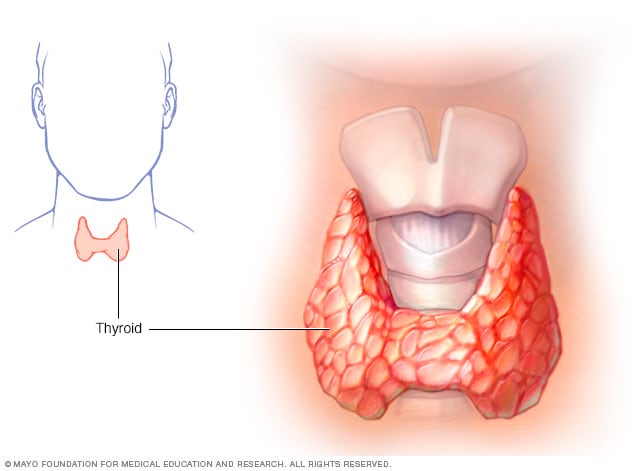
Hashimoto's disease is an autoimmune disorder in which your immune system creates antibodies that damage your thyroid gland. Doctors don't know what causes your immune system to attack your thyroid gland. Some scientists think a virus or bacterium might trigger the response, while others believe a genetic flaw may be involved.
A combination of factors — including heredity, sex and age — may determine your likelihood of developing the disorder.
Risk factors
These factors may contribute to your risk of developing Hashimoto's disease:
- Sex. Women are much more likely to get Hashimoto's disease.
- Age. Hashimoto's disease can occur at any age but more commonly occurs during middle age.
- Heredity. You're at higher risk for Hashimoto's disease if others in your family have thyroid or other autoimmune diseases.
- Other autoimmune disease. Having another autoimmune disease — such as rheumatoid arthritis, type 1 diabetes or lupus — increases your risk of developing Hashimoto's disease.
Complications
Left untreated, an underactive thyroid gland (hypothyroidism) caused by Hashimoto's disease can lead to a number of health problems:- Goiter. Constant stimulation of your thyroid to release more hormones may cause the gland to become enlarged, a condition known as goiter. Hypothyroidism is one of the most common causes of goiters. Although generally not uncomfortable, a large goiter can affect your appearance and may interfere with swallowing or breathing.
- Heart problems. Hashimoto's disease also may be associated with an increased risk of heart disease, primarily because high levels of low-density lipoprotein (LDL) cholesterol — the "bad" cholesterol — can occur in people with an underactive thyroid gland (hypothyroidism). If left untreated, hypothyroidism can lead to an enlarged heart and, possibly, heart failure.
- Mental health issues. Depression may occur early in Hashimoto's disease and may become more severe over time. Hashimoto's disease can also cause sexual desire (libido) to decrease in both men and women and can lead to slowed mental functioning.
- Myxedema (miks-uh-DEE-muh). This rare, life-threatening condition can develop due to long-term hypothyroidism as a result of untreated Hashimoto's disease. Its signs and symptoms include drowsiness followed by profound lethargy and unconsciousness.
- A myxedema coma may be triggered by exposure to cold, sedatives, infection or other stress on your body. Myxedema requires immediate emergency medical treatment.
- Birth defects. Babies born to women with untreated hypothyroidism due to Hashimoto's disease may have a higher risk of birth defects than do babies born to healthy mothers. Doctors have long known that these children are more prone to intellectual and developmental problems. There may be a link between hypothyroid pregnancies and birth defects, such as a cleft palate.
- A connection also exists between hypothyroid pregnancies and heart, brain and kidney problems in infants. If you're planning to get pregnant or if you're in early pregnancy, be sure to have your thyroid level checked
Treatment
Treatment for Hashimoto's disease may include observation and use of medications. If there's no evidence of hormone deficiency, and your thyroid is functioning normally, your doctor may suggest a wait-and-see approach. If you need medication, chances are you'll need it for the rest of your life.
Synthetic hormones
If Hashimoto's disease causes thyroid hormone deficiency, you may need replacement therapy with thyroid hormone. This usually involves daily use of the synthetic thyroid hormone levothyroxine (Levoxyl, Synthroid, others).
Synthetic levothyroxine is identical to thyroxine, the natural version of this hormone made by your thyroid gland. The oral medication restores adequate hormone levels and reverses all the symptoms of hypothyroidism.
Treatment with levothyroxine is usually lifelong, but because the dosage you need may change, your doctor is likely to check your TSH level about every 12 months.
Monitoring the dosage
To determine the right dosage of levothyroxine initially, your doctor generally checks your level of TSH after a few weeks of treatment. Excessive amounts of thyroid hormone can accelerate bone loss, which may make osteoporosis worse or add to your risk of this disease. Overtreatment with levothyroxine can also cause heart rhythm disorders (arrhythmias).
If you have coronary artery disease or severe hypothyroidism, your doctor may start treatment with a smaller amount of medication and gradually increase the dosage. Progressive hormone replacement allows your heart to adjust to the increase in metabolism.
Levothyroxine causes virtually no side effects when used in the appropriate dose and is relatively inexpensive. If you change brands, let your doctor know to ensure you're still receiving the right dosage.
Also, don't skip doses or stop taking the drug. If you do, signs and symptoms will gradually return.
When I was first diagnosed with hypothyroidism, I was told that my blood levels would have to be checked about every 6 months or so. Since being diagnosed with Hashimoto's, my doctors need to keep a closer look at my levels, So now I am supposed to get blood drawn every 2 months or so. I was also told that I have a very prominent thyroid. Doctors can easily see it just by looking at me and can tell it's larger than normal. So weird to me. It's amazing how many things this little gland can affect. I might have to do some more research. I know there are certain foods that I am supposed to avoid. Time to read up.
As far as the depression issue, I have recently had to go up in dosage on my medication. I am now at the highest dosage which is pretty terrifying for me. This has been the only medication that has fully worked for me. Now I feel like I'm nearing the end of this good run. I know I shouldn't think about that or stress about it, but at the same time, I can't help it. Hopefully this dosage will last for a decent amount of time, because I'm really not ready to go through all of the trials of every other medicine. And I already know they won't work because I've been on everything. Sigh. So.... trying to look on the bright side, but still scared.
Now for a harder topic. I experienced my third miscarriage in November. I was so happy to finally be pregnant again. We had waited 2 years for this to happen. There was a break in there because I needed to take some time for my emotional and mental state. I finally felt I was ready and it happened. The doctors got us in for an ultrasound fairly quick, but already something didn't seem right. Honestly, I didn't have a good feeling, but they wanted to give me another week to make some progress before they would do another ultrasound to be sure. Sure enough, as soon as the picture showed up on the screen, it looked no different than it had the previous time. I knew immediately. But I had an entire week to prepare myself emotionally. Well, as much as I could. I already felt differences in my body and I just knew. Trevor didn't have that. He was not prepared at all. I opted for the surgery again and decided to have the tissue sent off to be tested. Hoping that maybe they could figure out why this keeps happening. When the results came back in, we were all a little shocked. A normal baby has 46 chromosomes. 23 from each parent. Our baby had 92. This is what is called a tetraploid pregnancy and is apparently very rare. I wasn't really sure what to think, but my doctor seems to think that this should not have anything to do with having a healthy, normal pregnancy next time. Honestly, I feel pretty burnt out though. I'm just a little emotionally exhausted. I know I've always said that I'd have the babies I'm meant to have, but what if that means I'm not supposed to have any at all? I thought I had been dealing with this fairly well. Every now and then it hits me though. Three precious babies gone. I can't give up hope though. I want babies that I can teach music too and sing to them at night. I want to read them all kinds of books and help them learn everything they can. I've always dreamt of being a mother. If there is a higher power of some sort, I hope that they find me worthy of being a mother someday soon. I'm not sure how many more times I can go through these losses.


When I was first diagnosed with hypothyroidism, I was told that my blood levels would have to be checked about every 6 months or so. Since being diagnosed with Hashimoto's, my doctors need to keep a closer look at my levels, So now I am supposed to get blood drawn every 2 months or so. I was also told that I have a very prominent thyroid. Doctors can easily see it just by looking at me and can tell it's larger than normal. So weird to me. It's amazing how many things this little gland can affect. I might have to do some more research. I know there are certain foods that I am supposed to avoid. Time to read up.
As far as the depression issue, I have recently had to go up in dosage on my medication. I am now at the highest dosage which is pretty terrifying for me. This has been the only medication that has fully worked for me. Now I feel like I'm nearing the end of this good run. I know I shouldn't think about that or stress about it, but at the same time, I can't help it. Hopefully this dosage will last for a decent amount of time, because I'm really not ready to go through all of the trials of every other medicine. And I already know they won't work because I've been on everything. Sigh. So.... trying to look on the bright side, but still scared.
Now for a harder topic. I experienced my third miscarriage in November. I was so happy to finally be pregnant again. We had waited 2 years for this to happen. There was a break in there because I needed to take some time for my emotional and mental state. I finally felt I was ready and it happened. The doctors got us in for an ultrasound fairly quick, but already something didn't seem right. Honestly, I didn't have a good feeling, but they wanted to give me another week to make some progress before they would do another ultrasound to be sure. Sure enough, as soon as the picture showed up on the screen, it looked no different than it had the previous time. I knew immediately. But I had an entire week to prepare myself emotionally. Well, as much as I could. I already felt differences in my body and I just knew. Trevor didn't have that. He was not prepared at all. I opted for the surgery again and decided to have the tissue sent off to be tested. Hoping that maybe they could figure out why this keeps happening. When the results came back in, we were all a little shocked. A normal baby has 46 chromosomes. 23 from each parent. Our baby had 92. This is what is called a tetraploid pregnancy and is apparently very rare. I wasn't really sure what to think, but my doctor seems to think that this should not have anything to do with having a healthy, normal pregnancy next time. Honestly, I feel pretty burnt out though. I'm just a little emotionally exhausted. I know I've always said that I'd have the babies I'm meant to have, but what if that means I'm not supposed to have any at all? I thought I had been dealing with this fairly well. Every now and then it hits me though. Three precious babies gone. I can't give up hope though. I want babies that I can teach music too and sing to them at night. I want to read them all kinds of books and help them learn everything they can. I've always dreamt of being a mother. If there is a higher power of some sort, I hope that they find me worthy of being a mother someday soon. I'm not sure how many more times I can go through these losses.
Well now that we've ended that on a depressing, ranting note.... I just wanted to catch you guys up on what's been happening. I'm sure I missed something. That's just what happens when I don't map out my thoughts. Lists are my friends and I didn't make any. Sigh. Thank you to everyone who has been a huge support for me this past year. I've made some amazing friends and have been incredibly lucky in that area of my life. I hope you know who you are and I love you all dearly. Here's to things looking up, getting better, and becoming more awesome and kick ass! I'm trying to look at things in a positive light. I may not always be able to do so, but I'm trying.

No comments:
Post a Comment